

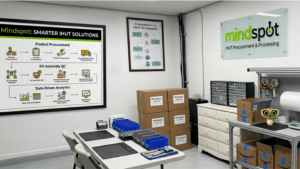
 An in-home usage test (iHUT) is a consumer research study in which real consumers receive a product, use it at home the way they normally would, and then rate the experience through a structured survey.
The best iHUTs follow up with focus groups or interviews to explain the numbers. The result tells brand teams whether a product, its packaging, or both are ready for market, and what small changes would make them stronger, before major money is spent.
Mindspot Research runs in-home usage testing from start to finish: study design, participant recruitment, product procurement, shipping, incentives, data collection, qualitative follow-up, and an executive-ready report. We run studies across the United States, Europe, and other countries, at sample sizes ranging from focused groups to large national studies.
What Is an In-Home Usage Test?
An in-home usage test, also called a home use test (HUT) or IHUT, puts a product into consumers’ hands in their own homes for a set period. Participants use it in their real routines rather than in a lab or a facility. They then answer a survey that measures what matters to the business, such as overall liking, purchase intent, performance on key attributes, and preference against a competitor or an alternative version.
Because people use the product in their real environment, the feedback reflects how it will actually perform after launch, not just how it looks on first impression.
What Can You Test With an iHUT?
Almost anything that can be shipped. Common objectives include:
- The product itself: performance, taste, scent, texture, ease of use, and whether it delivers on its promise.
- The packaging: opening and closing, dispensing, grip, storage, durability in transit, shelf appeal, and on-pack communication.
- Product and packaging together: the full experience from the moment the box arrives to the last use.
- Competitive comparisons: your product tested side by side with, or blind against, leading competitors.
- Version testing: two or more formulations, designs, or packaging options to identify a clear winner.
- Instructions and claims: whether consumers understand how to use the product and believe what it says it does.
How Mindspot Runs an iHUT, From Recruitment to Executive Report
Our clients get one partner who manages every step, so their team can focus on the decision rather than the logistics.
- Design the study around the business decision. We define what needs to be learned, which products or versions to test, the use period, and the measures that will drive the go/no-go or optimization call.
- Recruit the right participants. We find and screen consumers who match your target, whether that is current users, competitor users, or a specific demographic or behavioral group.
- Procure the products, including competitors. We source competitive products so comparisons are fair, and we can repackage or blind them when the design calls for it.
- Handle distribution. We ship products to participants’ homes and manage tracking, replacements, and timing.
- Incentivize participants and collect the data. Participants use the product as directed and complete a quantitative survey, which gives you statistically measurable results.
- Go deeper with qualitative follow-up. We invite selected participants into online focus groups or interviews, using Mindspot’s two-moderator approach for deeper probing. This is where you learn why people rated the product the way they did.
- Analyze and report for leadership. You receive a clear, decision-focused report built to share with senior management and executives, with findings, implications, and recommended next steps.
Why Combine Quantitative and Qualitative Research in One iHUT?
Numbers tell you what is happening. Conversations tell you why. A survey might show that 40 percent of participants struggled to open a package; a focus group reveals that the tear strip is hard to find and that a small visual cue would fix it. Pairing the two in a single study gives you both the confidence of measurable data and the specific direction needed to act on it, without running two separate projects.
iHUT at Scale: United States, Europe, and Beyond
Some decisions need a small, targeted read. Others need a large sample that leadership will trust before committing to a national or multi-country launch. Mindspot is built for both. We run large-sample iHUTs across the United States and in Europe and other countries, managing recruitment, shipping, and local logistics so results are consistent and comparable across markets.
iHUT vs. Ethnography vs. Central Location Testing
These methods are often confused. An iHUT is not ethnography. Ethnography relies on a researcher observing people in their daily lives to understand behavior in depth. An iHUT puts the product to work and measures how it performs, at a scale that supports business decisions.
| In-home usage test (iHUT) | Ethnography | Central location test (CLT) |
Where it happens | Participants’ own homes | Participants’ homes or daily settings | A research facility or venue |
Who drives it | The consumer uses the product, then reports back | A researcher observes behavior in context | Participants try the product on site under supervision |
Main output | Measurable performance and preference data, plus the reasons behind it | Deep, exploratory understanding of behavior and culture | Quick reactions in a controlled setting |
Sample size | Small to very large; built to scale | Usually very small | Moderate, limited by venue |
Best for | Go/no-go and optimization decisions on a real product or package | Early discovery before a product exists | First impressions such as taste, look, or smell |
When Should You Run an In-Home Usage Test?
Run an iHUT before any decision that is expensive to reverse. Typical moments include:
- Before launching a new product or line extension.
- Before a packaging redesign or a move to more sustainable materials.
- Before reformulating or cost-reducing an established product.
- When you need proof that you beat, or match, a key competitor.
- When choosing between two or more finalist designs or formulas.
Before you spend heavily on production, tooling, or a launch campaign, you should know whether you are heading in the right direction, or whether a few small tweaks would make the product perform even better.
Frequently Asked Questions About In-Home Usage Testing
Is an iHUT qualitative or quantitative?
It can be either, but the strongest iHUTs are both. Mindspot typically collects quantitative survey data from all participants, then follows up with focus groups or interviews among a subset to understand the reasons behind the results.
How long does a participant use the product?
The use period is set by how the product is used in real life. A single-use item may need only one session, while products that are used daily or need to prove durability are tested over a longer period.
How many participants do you need?
It depends on the decision. Small samples work for directional learning, while go/no-go and multi-market decisions call for larger samples that support statistical comparisons. Mindspot designs the sample to fit the decision and can scale to large national studies.
Can you test our product against competitors?
Yes. Mindspot procures competitive products and can run branded or blind comparisons.
Can an iHUT be run in more than one country?
Yes. Mindspot runs iHUTs across the United States, Europe, and other countries, with consistent methods so results can be compared across markets.
What do we receive at the end?
A decision-ready report designed for senior leadership, covering what consumers think, why they think it, and what to do next.
Test It in Real Homes Before You Bet on It
Mindspot Research designs and runs end-to-end in-home usage tests that combine large-scale quantitative data with in-depth qualitative insight, delivered in a report your executives can act on. Contact our research team to plan your next iHUT.


